Wednesday, January 2, 2019

36 Post-Apocalyptic Treasures + Simple Rules for Radiation, Chemicals, Magazines, and Headgear

I've always been a big fan of post-apocalyptic settings. The weirder they are, the more I like them. I loved Unlawful Games' D100 post-apocalyptic loot tables I saw a while back, or more accurately, the D10 treasures from the end. Dan's post-apocalyptic nuns post also brought the apocalypse back into my mind. So did an end of the year discussion about the best videogames this year where me and my friends agreed Slay the Spire will probably be Game Of The Year when it releases next year for a lot of people, which reminded me that the excellent dying earth science fantasy acid trip that is Caves of Qud likely will be mine.


I also watched Isle of Dogs recently, which is surprisingly apocalyptic in aesthetic. Good movie.

So I thought I'd put together some treasure tables, and then I had to tack on some rules ideas to explain some of their mechanics, and then I had some ideas for locations, gods, and creatures which I'll put up in another post. This is a D66 table, which means you roll a two D6s - the first one is the tens digit, the second the ones digit. So a roll of 2 and 5 becomes 25, a roll of 6 and 1 becomes 61, etc etc.

Some Assumptions
There are psychics. I have a homebrew system for psychics but it is poorly tested and not to everyone's taste - I've tried to make the psychic-related items be not too tied to my system.

Mutations are common and unrealistic. Think Nuclear Throne, not Mad Max.

The Old World got up to some crazy levels of technology. They may well have had extra-solar colonies by the time it all came tumbling down.

There may be supernatural elements (beyond psychics, of course). Some of the items are certainly a bit more than just mundane, but the setting need not be explicitly or even secretly supernatural.

Without Further Adieu...
All items occupy one inventory slot except for those in italics, which occupy none.


11 Brain Enhancement Box: A metallic box that can be attached to the back of a person's head. It drills inside, attaching itself to the spine and prompting a Constitution test. On a success, all mental stats are raised by 2. On a failure, the BEB is simply wasted. On a critical failure, the BEB kills the recipient. Some Old World machines can determine if someone is a viable recipient (IE they make their test before actually plugging the BEB in).

12 Laserblade: A small metal handle which, when a button on it is pressed, projects a beam of powerful energy the length of the average sword. The sword counts as a Masterwork Sword (D6+1 damage, Melee range, 1 hand), but ignores physical armour and can be used to (slowly) cut through all but the hardest metals. However, energy shielding completely blocks the blade. Casts dim light up to Reach distance.

13 Energy Shield: A small metal belt that can be worn comfortably (albeit taking up an inventory slot). It provides 1 Armour while activated and blocks all energy damage, both incoming and outgoing. While in use, it projects a light blue field an inch above the wearer's body, that smells faintly of ozone.

14 Antigravity Harness: A harness that can be adjusted and worn comfortably over most forms of armour and clothing. By manipulating dials on the harness' front panel, its antigravity effect can be triggered, pulling the wearer up and down up to ten metres above whatever is below them. If set to the maximum, the antigravity effects will soften a fall, allowing the wearer to ignore up to the first fifty metres of what would otherwise be falling damage.

15 Neuromod: A handheld device which can be placed against an eye and activated to shoot inside and connect to the nervous system. It can then "drain" a single skill the target knows, recording it and removing all knowledge of it from their mind. The Neuromod can then be injected into another person's eye to give them that skill, but in doing so, the device is rendered unable to be used again. A target need not be compliant but struggling will lead to their death and loss of the knowledge. As such, unwilling targets should be coerced or rendered unconscious.


From Prey (2017)

16 Translator Bracelet: Worn on the wrist, this heavy computer automatically translates into and from all languages known to the Old World. It is also capable of adapting to new dialects and languages, recording, analyzing, and putting together new discoveries about languages translated by whoever wears it. However, the robotic voice, go-between nature of the device, and tendency to speak as formal as possible incurs Disadvantage on tests related to charisma – but not clarity, as the translation is always sufficient.

21 Psi-Crown: Whoever wears this ring of metal plates around their head is immune to all assaults on their mind. They cannot be directly targeted by psionic powers that affect the mind and their soul is invisible to creatures who can see them. They could be lifted by telekinesis, or set aflame by pyrokinesis, but not have their mind read or senses altered. Psychics who wear Psi-Crowns are unable to use any of their powers. The metal is soft, chosen for its ability to block psionics and not bullets, and does not count as a helmet.

22 Pain Grenade: When activated, this grenade-like object projects a feeling of intense psychic pain after a few moments (so that you can throw it), incapacitating everyone within Reach distance. Each round they may make a Constitution or Body Save to act, but only slowly and shakily. The grenade can be deactivated early by pressing the button, but will deactivate automatically after a minute.

23 Cloak of Confusion: A blue, starry cloak which, when worn, renders it and anything it covers unable to be acknowledged by intelligent creatures. Anything that touches it, however, is able to acknowledge it, and can actually see through the cloak. If not touched by a living creature, its power will not be activated, letting it be seen by people while not in use. The power only affects creatures who see the cloak with their own vision – recordings show it as normal, soulless (but not free-willed) robots can see it, and it triggers things like laser alarms and proximity activated doors.

24 Psi-Monitor: A phone sized handheld computer. When psychic abilities are used within proximity of it – either their effects or their user are within range – it buzzes to alert its bearer and records what type of psychic effect was used. The average range is Near, but exceptionally strong uses of psionics may extend this range to Far and exceptionally weak or well-controlled normal uses may shorten it to Close.

25 Shimmer: A psychic drug, purple and shimmering (hence the name) and inhaled through the nose. If consumed by a psychic, they recover to their maximum Psi, or recover to their maximum uses of psychic powers per day, or recover all committed Effort for the day, or clear all the cooldowns on their powers, etc etc. If used by a non-Psychic, they get to use a single Precognition power with 4 Psi or 1 Effort, etc etc. When Shimmer is used, roll a D6 – on a 1-2, the drug runs out.

26 Curious Icosahedron: A blue crystal with twenty sides. It feels lucky. Whoever bears it can choose to reroll any failed D20 roll they make, taking the new result if it is better, but in doing so the crystal shifts to red and feels unlucky. They must reroll another D20 roll and take the worse result in order to shift it back to blue. The crystal can only be used once per direction per day.

31 Autodoc Helm: Worn on the head, this white and red plastic and metal helm resembling a targeting rig. Instead of assisting in combat, however, it gives advice and information related to medicine. It allows the wearer to reroll Fumbles on rolls related to medicine, surgery, and diagnosis.

32 Blood Rifle: As a normal Assault Rifle (D6+1 damage, Near range, 2 hands), but every time it deals damage to an organic target, the wielder heals 1 HP. The rifle is made of bone with red, fleshy decals between and beneath the bone. While it loads normal ammunition, its shots are bright red and splatter blood where they strike.

33 Shipskin: An organic suit which remains in a dormant state until fed. One ration gives the Shipskin enough energy for a day, during which time it recycles oxygen, reduces radiation by one step (or otherwise provides partial protection against it), and resists pressures from 0 to 100 P. It can be fed extra rations for up to a week of advance feeding. In an emergency, Shipskin can be eaten for one ration per stored ration, and one extra ration if you eat it all (which destroys it). When worn it appears a thin layer of pink transparent goop over the body, but is warm to the touch and feels stretchy but not slimy. It fits over everything except power armour, and fits under power armour and similar clothing easily. It does not hinder movement at all.


Shipskin is designed for use in space, and grows bloated when overfed. Image from Prophet.

34 Diagnostic Scanner: A handheld computer that scans organic creatures within Reach distance of it when activated. It analyzes them over the course of a few seconds, determining what ails them, such as diseases, internal injuries, or mutations. If used on a corpse, it will determine what killed the corpse. The scanner can offer no aid in how to cure ailments, but has 95% accuracy in diagnosis.

35 Super-Salve Injector: A salve injector, but clearly marked as well beyond a normal injector's ability. Heals a single organic to full HP, of all injuries, diseases, and radiation, and raises all physical stats by 1. If used on someone who has died within the past minute and whose body is still relatively intact, it restores them to life but rather than raising their physical stats, it lowers them each by 1.

36 Medical Omnibus: A thicky, heavy textbook that covers the most important details of nearly every Old World medical discipline. It can be read before performing medicine to gain access to the Medicine skill, or to gain Advantage on medical rolls or the ability to perform complex procedures if you already have the Medicine skill. It functions like a magazine in this fashion, but unlike a magazine, the Medical Omnibus can be used indefinitely as the breadth of its knowledge is wide and the quality of its paper enough to prevent damage during reading.

41 Glowing Headband: A green headband which glows like radioactive materials. If worn, the headband functions like a normal headband (+1 unarmed damage), but allows the wearer's arms to stretch. Their melee and unarmed attacks have Reach range, and they can grab things at that distance comfortably.

42 Irradiator Rifle: A rifle (D6+1, Near range, 2 hands) that loads batteries and fires large beams of radiation. They do not cause mutations/saves against radiation, but they do ignore armour and cover. Anti-radiation armour blocks the beams entirely, and irradiated creatures and all robots are immune to the damage.

43 Radsuit: A HAZMAT Suit that protects against radiation like a normal HAZMAT suit, complete with a gas mask. This one, however, is bright green instead of bright yellow, and renders the wearer completely immune to radiation. The kind of radiation that can penetrate it is the kind that'll burn you before it poisons you.

44 Water Purifier: A heavy object which filters water of everything, including radiation and disease, rendering it good to drink. It takes one hour to purify enough irradiated water for a person to drink for a day. The energy it consumes is so low that a handcrank attached to its outside can charge it for an hour if wound for ten minutes by hand.

45 Mutagen Injector: A tonic injector containing a glowing green liquid clearly radioactive in nature. It is warm to the touch, and yet it does not project radiation. When injected, the target gains a random positive mutation. If injected into a character of a mutant class or race, they roll twice and pick which mutation.

46 Rad-Crystal: A glowing hunk of green stone on the end of a pendant. It does not cast its radioactive glow however, instead appearing to draw it in from it surroundings. When worn, it grants the wearer Advantage on Saves vs Radiation.

51 Warhelm: An Old World military helmet. Counts as a helmet and targeting rig at the same time.* Looks operator as fuck, granting +1 to reaction rolls with soldier-types.

52 Rocket Launcher: Loaded with one rocket with D6-1 extra ones beside it. Attacks deal 2D6 damage to all creatures within Reach distance of where it hits, or D6 vehicle damage to a single vehicle. Autohits at Close or Near range, but can fire up to Far range away with a successful Ranged Attack.

53 Carbide Armour: The pinnacle of Old World armour. This armour counts as Light Armour but provides 2 Armour instead of 1. The suit is clearly military in nature.

54 V8 Engine: A engine of unsurpassed power. When installed in a vehicle, it grants Advantage to all tests related to speed and endurance, and raises its top speed by a suitable amount (enough to make it to the next "level" of speed).

55 Meal Replacement Pills: A tin of 28 dense, large pills that can be chewed and swallowed in under a minute. Each pill has a single, light flavour such as ice cream or butter chicken, and provides all the nutrition you need for a day. As a result, a tin of MR Pills provides a month of rations in a single inventory slot.

56 Terrarium: A glass bottle full of dirt and a self-sustaining ecosystem. The glass is heavy duty, very hard to break and able to hold out any degree of radiation. Its mere presence inspires hope, and a party that carries it has Advantage against Fear (if a PC) and +1 Morale (if an NPC). If it breaks, however, the despair causes everyone in the party to lose 2000 experience (but do not lose levels).


The world's oldest terrarium. Imagine this but the size of his head instead.

61 Gashelm: An unholy combination of gas mask and helmet that somehow manages to combine the two without losing functionality. The wearer counts as wearing both of those and grants +1 to reaction rolls with tinkerers.

62 Jack the Ripper: What can only be described as a chainsaw sword, blue metal with the words "Jack the Ripper" written on it in red paint. It counts as a normal sword (D6+1 damage, Melee range, 1 hand). It clatters loudly as it spins, and the blades rip through the toughest metals with ease – but only if they catch right. Barring the most exceptional circumstances (such as being wielded by true swordmasters, or those with incredible hand-eye coordination), it has only a 50/50 chance of dealing damage, but when it does, it deals double damage automatically. Triumphs (critical successes) always deal damage, and four times the result rolled, at that.

63 Rad-Diver's Armour: A HAZMAT suit covered in pieces of leather, chainmail, and thin sheets of metal. It provides all the radiation protection of a normal HAZMAT suit and comes with a gas mask, but also counts as Light Armour.

64 Carpoon: To call it a weapon is inaccurate. It can be wielded in both hands and fired with Disadvantage, but the Carpoon is meant to be mounted on a vehicle. It fires a long metal rod which deploys hooks on contact (but only grapples living creatures if it reduces them to 0 HP, at which point they're dead so it doesn't matter). It deals D6 damage or 1 vehicle damage. After an attack, it pulls back to reload in a round, or to drag whatever it's hit along with the vehicle it is attached to.

65 Uberhulk: Hulk is a drug that strengthens the body at the expense of its health, as the muscles work with strength that rips and tears them apart. Uberhulk has a permanent effect, raising your Strength by 4 but lowering Constitution and Dexterity by 1 each, to the normal maximums and minimums of 18 and 3. An injector only works once, and being injected twice causes severe muscular atrophy.

66 Shaman's Bell: A bell made of scrap metal from at least a dozen sources. When shaken vigorously, the discordant noise it creates confuses all creatures and intelligent robots who can hear it (typically up to Close range away), stunning them for a round. The ringer is stunned as well, however, and cannot act the next round.

Radiation Rules
Radiation provokes a Save vs Radiation after a certain amount of time spent in its presence. Stronger sources prompt quicker tests and radiation-blocking items reduce the effective strength of a source. On a success you take 1 damage per level, on a failure you take D6 damage per level. Being reduced to 0 HP or below by radiation prompts Save vs Death. On a failure you die, on a success you suffer an injury from the table below:

Radiation Injury Table
1    -2 Constitution, hair loss
2    -1 Constitution, -1 Wisdom
3    -1 Constitution, -1 Dexterity
4    Mutation, Save or gain another.
5    Blinded.*
6    Lose 1 maximum HP per level.

*Injuries marked with asterisks prompt a Save vs Death at the end of a week to clear them. On a failure, they persist until the next month, where another Save vs Death clears them. If you fail both Saves the injury is permanent.

Severity
Save once per...
Examples
Minimal
Watch / 4 Hours
Outer space, the rad-desert.
Low Hour The toxic jungle, beneath the green comet.
Medium Turn / 10 Minutes A long-dead city, in a poorly-filtered vault.
High Minute A nuke's blast zone, next to leaking barrels.
Extreme Round / 10 Seconds The heart of a reactor, a nuke's ground zero.

In addition, drinking irradiated water, being struck by irradiated weapons, and other such events all provoke an immediate Save vs Radiation.

Certain items reduce radiation severity. A HAZMAT suit, gas mask, and the chem known as Blocker all reduce a character's suffered severity by one step each.

My reasoning behind radiation is to make it really scary. Real world radiation is frightening, so should fantasy radiation. A level one PC is as likely to be killed by radiation as a level ten one, albeit not quite as much thanks to their saves, and it kills faster than normal damage does in my rules for injuries and death. The injuries are worse than average, too.

Resisting radiation isn't too hard if you have the proper gear, but you can only wear one armour, one helmet, and be on one chem at a time. To resist it fully, you have to forgo a lot of these items. In addition, radiation is not always easy to detect. Without a Geiger counter or careful observation, it's possible to stumble into doses much higher than anticipated. Both PCs and their players aren't made aware of hidden radiation until they must make Save.


Some anti-radiation gear. - by shaonizzit

Chemicals
Chemicals provide a benefit and a drawback for a certain amount of time. Excessive use of the same chemical – think several times in a day, or once every day or two for a week or so – can prompt addiction, which causes the PC to suffer the chem's negative effect even when they are not using the chem. Chems without negative effects are non-addicting. A PC can only be on one chem at a time. Taking a new chem does nothing but waste it.

Hulk: A chem named for an Old World god of strength and rage. When injected, the user's muscles have their normal limits lifted, granting them Advantange on all Strength and Melee Attack rolls for two minutes – but dealing D6-1 damage each time such a roll is made.

Salve: An Old World chem found in injectors. Salve calms the nerves, soothes pain, and pumps the body full of chemicals involved with healing and adrenaline. In doing so it heals the recipient for D6+1 HP, and with no negative side effects. Attempts to use it more than once every ten minutes fail due to the fact that one Salve is already doing all it can do.

Blocker: One of the few Old World chems successfully reverse-engineered, and for good reason. It reduces incoming radiation by one step for a day, very useful in the irradiated wasteland, and is hard to scavenge due to the fact it was only rarely used in the Old World, and often in locations which are now flooded with lethal radiation.

Helmets and Headgear
Pieces of headgear (usually, headbands are one exception) take up one inventory slot and you can wear one at a time. They all provide benefits to the PC who wears them, often in the form of letting them reroll Fumbles (critical failures) of a certain kind.

Helmet: Military helmets. Renders you immune to critical damage from enemies - critical hits are treated like normal hits.

Targeting Rig: A military targeting computers attached to the head. Let you reroll Fumbled ranged attack rolls, as the computer helps aim your shots.

Gas Mask: Filters all but the most insidious gases, as well as airborne radiation, poison, and disease. Old World filters last for months of use, long enough to be irrelevant. This raises your radiation protection by one Rad Level, or to Rad Level 1 from 0.

Headlamp: A lamp attached to the head, which projects a strong beam of light up to Close distance in front of the wearer's direction of view. They usually run on Old World batteries as a flashlight, but some are modified to function with oil or candle light. Needs no hands.

Snazzy Hat: An Old World top hat, or New World shaman's regalia, or anything else suitably impressive (and large enough to take up an inventory slot). Grants +1 to reaction rolls with those who would look favourably upon it (an officer's cap might grant +1 with soldier-types, while a bishop's hat might grant +1 with the particularly religious).

Headband: Signifies physical prowess, granting +1 damage with unarmed attacks. Many headbands have storied histories and a large collection is said to bring fate's favour. As a result, owning a headband will often bring bounty hunters upon you.

Yes, headbands are mostly here to reference Afro Samurai.

Magazines
Old World magazines, rotting and falling apart. Opening and reading one requires an hour and will render the magazine ruined once finished, but will give the reader access to the skill the magazine concerns until they next sleep. If they already have the skill, the magazine will instead give them Advantage on such rolls or allow them to perform tasks beyond even their capabilities. If using a system with skill points, treat them as granting a 4-in-6 or 66% rating.

From Fallout 4

Monday, December 17, 2018

Mothership: Two Creatures, a Class, an NPC, a Goddess, and a Flying City

Here's some more stuff for Mothership. However, aside from the Innocent (which is really just a character archetype), you could use most of this in any system and setting.

Garuda
Named for the legendary mount of the Hindu god Vishnu, Garuda are genetically engineered birds with internal antigravity plates, designed to carry passengers as they fly.

By Moebius

The largest birds in Earth's history had wingspans of around twenty four feet, around seven and a third metres. The largest living ones are albatrosses, with wingspans of eleven and a half (three and two thirds). On alien worlds, with denser atmospheres and lower gravities, the largest wingspan yet found is the thirty feet of M. lindberghii, native to the Company colony of New Kinshasa.

But even on these low gravity worlds, the dream of the flying mount was just a dream, and nothing more. Until Company analysts started to send surveys to the rich and powerful. It was slow going at first – advertisements are for the unwashed masses, after all – but once they started getting responses, the idea was floated and positively received.

Each Garuda is more wing than body, and their brains are simple, unable to do anything but fly at their jockey's command. Garuda "feed" on a high energy predigested slurry, which is pumped into their bodies by connecting a hose to the creepy metal nozzle they have in place of a throat. The slurry is filled with nutrients, energy, and oxygen, capable of sustaining them for days of flight and weeks of downtime between feedings. Their legs are merely vestigial, and they rest on rotund bellies softened with fat not for their comfort but for their rider's, so that landings are cushioned.

By James Gurney

You might be thinking: "Hey, I know this is scifi, but how on earth were they able to design a flying mount?" Well, that's because their designers cheated. Every Garuda is filled with artificial gravity plates. The smallest models might have a single one just to keep them afloat, but larger types have several, as much an agrav* with an organic shell as they are an actual animal. They are still propelled by muscle, of course, but pedants are quick to complain that you might as well cover an agrav with feathers and say it's a beast as well.

The smallest Garuda are designed to carry a single rider and little else. The largest, often referred to as "sky-whales", have multiple sets of wings and entire rooms built on their backs and bellies, or even into their bodies. The newest "Leviathan" models have a single spiral staircase that can take you from a viewing dome on the top to another on the bottom in less than a minute of walking.

While initially designed and mostly made for luxury purposes, Garuda have found some limited use in search and rescue, exploration, and military roles. Their use of agrav plates doesn't require that they hold up the full weight of what they carry, and as they are mostly organic, the weight they do have to support is much less than that of a metal vehicle. On worlds where supply lines are non-existent, such as backwater colonies or uncharted systems, the expense of a Garuda can be worth taking one in place of an agrav. In terms of weight, carrying slurry tanks is more efficient than carrying fuel or batteries, making them well suited to situations where recharging from a generator is not a reliable option.

*An agrav is a vehicle which makes use of antigravity or artificial gravity plating to fly. Some ground vehicles or conventional planes and helicopters use agrav plates to support themselves, but an agrav vehicle is one that is fully dependent on their use.

Muninn
Intelligent – though only protosapient – crows with recording and tracking devices embedded into their bodies, as well as chameleonine feathers and the ability to speak and even hold simple conversations. They are named for one of the two ravens of the Norse god Odin, who were said to fly across the world at dawn each day, returning to the god at dinner to recite what they had learned in their travels.

By Darko Tomic

Their species implies their most common use, which is to hunt, tracking quarry via a "third eye" camera set between their two true ones. It can show them images in infrared, light amplified, and just generally magnified forms. Most of their extra brainpower is devoted to understanding the nature of tracking, to be able to predict where a target will go even when they can't see them.

A Muninn's feathers are capable of changing colour like a chameleon's scales. They use this ability mostly at a distance, blending in with the sky before shifting to a normal colour when they perch alongside other birds. Crows are among the most common Earth transplant species in the human sphere, ensuring they blend in on most planets. For those worlds where they don't, specially made non-crow versions are available.

Because Muninn are, aside from their camera and brain augmentation, functionally identical to a crow, they are difficult creatures to track. In extreme situations such as after EMPs or when communications channels are being monitored or jammed, a Muninn can function without their implants or without radio connection. In fact, most Muninn "run dark" by default, only transmitting recorded information via a physical connection to prevent their communications from being tracked. Or just by talking. Did I mention they can talk?

Huginn and Muninn, Odin's raven scouts, were granted the ability to speak. The modern Muninn is no different. Talking pets have been around for centuries at this point, and the general agreement has been that anything that isn't an uplift – and therefore not a pet – is boring at best, unsettling at worst. Because speech is not typically necessary for animals, and is expensive and slow to augment into a creature, it is rarely granted. But Muninn can make use of it, both to transmit the information they've received and to carry messages of their own.

By Front 404

The supernatural elements of Mothership give hope that there may be psychics, souls, and even afterlives in the setting (there certainly are in mine), but at least in our reality, entropy always wins. If something can be spied on, it will be spied on. No defense is impenetrable, and so even the most secure lines of communication can be monitored, bugged, and recorded. Forget your enemies – the Company will gladly spy on anyone they think it could be worth watching.

Muninn help escape this problem. There's no phone to be bugged, no databank to steal and crack. The crows aren't intelligent enough to understand the messages they're carrying, or be bribed or tortured into revealing them, and, as of yet, the organic brain proves impossible to read via technology. (In those few places where psychics are starting to become exploited, animal brains are actually harder to read than human ones.) They can carry a message, unseen and unheard, and even elaborate on it. They can record a response and return to their owner with it. Due to their organic nature, they can even fly for days, weeks in some rare cases, to carry a message "as the crow flies".

A Muninn can be killed by a firm punch, but landing one is not easy. Hitting an unaware Muninn requires a normal Combat test, but hitting a Muninn that's actively moving requires a critical hit. Hitting an aware, flying Muninn at anything but the closest ranges is an exercise in futility, and requires a roll of exactly one. If you hit a Muninn, it has only 3 HP.

The Lady In White
A celebrity bodyguard for those in high society. No one knows what she looks like or even what she sounds like, as she always wears the same white bodysuit with a mask and voice scrambler. The only part of her anyone can see is her snow white hair, always worn in a bun. She favours close-range combat, and carries a katana, kris, and Scholz and Vogel "Fafnir" plasma pistol.

In addition to being a fashion statement, branding image, and easy way to stand out in do or die situations, the Lady's suit is also a highly advanced piece of armour. Despite being almost skintight and highly flexible, the suit has been shown to block bullets and blades in the several recorded fights she has been in. Her aversion to being hit indicates it isn't able to always block such strikes, but there are purchasable models of armour roughly comparable to what she wears. If you had millions of dollars to spare, at least.

Everything she wears, and every weapon she wields, is coated in a superthin layer of a highly hydrophobic substance. This gives it a brilliant sheen, but more notably causes blood to slip off of it in a few short seconds. By the time she sheathes her blades, they and her clothes are as white as they were before, leaving her immaculate and untouched.

The Lady has become notorious as a mysterious figure of uncanny grace. Clients hire her as much for her ample skill as for the status of being protected by her, and those who have the fortune of speaking to her describe her as cold, sarcastic, but ultimately an interesting person to talk to. But make no mistake: the Lady does what she does for the thrill of the fight, not for a place in high society. At the slightest sign of threat, she jumps from casual conversation to active combat in the blink of an eye, before returning without so much as acknowledging the combat once the all clear is sounded. Or not returning, if she was finding the conversation boring.

She prefers to take contracts she expects will have a high chance of seeing actual combat, and as a result tends to guard the kind of executive PCs will want to kill or manipulate. The Lady has developed a reputation as a duelist, challenging those who insult or rival her to legal duels, and offering herself as a champion to those challenged by someone or someone with a champion she wants to fight.

Combat 67%
Armour 3 or 2
Body 40%
Speed 50%
Instinct 33%
Health 60 or 15
Attacks Katana: 3D10 or D6+1, 2 Hands
Kris: 2D10 or D6, 1 Hand
Plasma Pistol: D100 or D6+2, Armour Piercing, Close range, 3 shots, 1 Hand
Special When the Lady in White would be brought to 0 HP or below, she instead remains at 1 HP, but is stunned for a round – she has never had her armour broken before, and so the feeling of blood seeping into her suit and sight of the growing red stain shocks her. If this happens again in the future, she will again be stunned, as she is not used to the pain.

A short, lithe woman in a white bodysuit with a featureless white mask and snow white hair tied in a bun. When she speaks, the voice is clearly not her own, and slowly morphs to another voice over the course of her conversation. She carries a sheathed katana, kris, and holstered plasma pistol, and walks and talks with the utmost grace.

The Innocent
Mothership is very clearly based on Alien and Aliens. There are other inspirations, and you could use the game to run a non-horror game just fine (although at that point it might be better to use a different system like Traveller or Stars Without Number), but it's the Alien series, and especially the original two, that seem to be the main source.

The classes in Mothership are Teamster, Scientist, Android, and Marine. The only one that doesn't have a clear inspiration in Alien or Aliens is the Scientist, and even then scientists practically dominate the rosters of later installations like Prometheus or Alien: Covenant.

But there's one classic character left out: Newt.

Isn't she adorable? - From Aliens

Not everyone in the depths of space is there to kill or be killed. Well, everyone can be killed, but not everyone signed up to do a risky job. Sometimes, people find themselves in the strangest situations through no fault of their own, or tag along on the journeys of others with no intention of taking part in the difficult work.

But they are far from useless. Their optimism and presence grounds those around them to their humanity, reminds them of what they have a chance to be a part of. When facing inhuman monsters and impossible odds, amorality and nihilism cling to humans like a disease. If you gaze into the abyss, the abyss gazes back – and with the number of monsters the average adventurer fights, it's all too easy to become one themselves.

And innocent does not mean incapable. Where other characters have strong weapons and sharp minds to protect them, the Innocent must stand against their foes alone. They have their friends for sure, but to stand alongside larger-than-life characters without running in fear requires even more courage than them. And because everyone gains the same skills and stats each level, the Innocent will eventually be as strong as their allies.

The Innocent are orphaned kids picked up from lost colonies and the significant others of crewmembers. They're therapists and priests. They're artists and philosophers and free thinkers. They're all the people we think are useless but couldn't do without. When a Marine takes a life, he does it to protect them – when a Scientist makes a breakthrough, her knowledge will improve their lives. We are what we fight for, and we fight for them.

Stats: +5 Speed, -5 Combat

Saves: 30 Sanity / 60 Fear / 20 Body / 30 Armour

Stress: Spend a round to calm someone down and let them reroll a Fear save or panic check.

Skills: Rimwise, +3 Points

The Goddess of Lost Things
In a setting with explicitly supernatural elements, however rare and unknown, religion is not something so easily shed. Most sci-fi settings tend to push it to the background, making characters with faith often zealots or aliens (or both).

But in the depths of space, society diverges from the norm. Lost colonies can go decades or even centuries before being recontacted, and in that time, a small initial population can rapidly expand. New religions develop, as do new takes on old ones. It's human nature to push the boundaries of what is normal, and a predominantly atheist or agnostic civilization will only have its religious members gravitate to the fringes, fringes where communication delays and unnatural living conditions promote new ways of thinking.

From Netrunner - by Yog Joshi (the art, not the game)

While all but the most ancient and venerable religions tend to stick to their systems of origin, one faith – if you can even call it one – has spread far and wide. The Goddess of Lost Things, patron of travellers, explorers, and refugees.

Her worship does not demand that she be praised before any other. Indeed, she has no priests or priestesses, no holy books or commandments. Her temples are hostels, her prayers meant to inspire hope, not devotion. Countless people who have no doubt that she does not exist pray to her all the same.

The Goddess of Lost Things is worshipped by those far away from home. Travellers and explorers, but also refugees and, naturally, the homeless. She requires nothing, but offers subtle intervention in return for prayer and sacrifice. Many who "worship" her are completely atheist, only making the prayers for their own comfort. Having something to have hope in, even if you know for certain it's unreal, can make all the difference.

Her favour is purported to come in many forms. Simple things like safe journeys and interesting expeditions, or large things such as finding new homes and escaping hostile pursuers. Her most ardent worshipers are not wanderers, but rather the once homeless or displaced who, after praying to her, found a way out of their situations and feel the need to repay her through continued worship.

While they are her most zealous followers, her most common ones are travellers. Deep space explorers, Company couriers, and interstellar haulers offer her prayers and build shrines on their ships. They hope for safe, quick travels, but more than that, the religion offers them something to focus on on the long journeys between the stars.

For those with more faith, the closest thing to a structured church she has are the Temples to Lost Things. They tend to be found in and around starports and other places where travellers congregate. Each is more or less a glorified hostel, run by those faithful in the Goddess and designed to be as cheap as possible. All profits are put back into funding the temple or towards charities that help the homeless and displaced – those in great need of shelter, like refugees or runaways, are often allowed to stay for free.

At the centre of every temple is a Shrine of Lost Things. (The Goddess' followers aren't the best at naming things – with so many languages they encounter, fancy names are eschewed in favour of easily translatable ones.) Those who wish to curry her favour, or pay what they feel is a debt owed, leave things of value to themselves. It is generally believed that this has more to do with internal value than external measures like price.

By Moebius

As a result, her shrines are full of the strangest items. Stuffed animals and favourite books up to priceless antiques and life-saving weapons. Anything someone might consider valuable. But more than that, the most externally valuable things are taken, because the shrine's items are open for the public to claim. People who abuse this are refused the right (many temples impose a one-item-per-person rule), but over time, items of any degree of value are taken away, leaving only the eclectic and unusual behind.

Envolant, the Flying City of Hostages
What's the best way to show off your unimaginable wealth? One is to build a flying city.

I swear, you could take anything made by Moebius and turn it into a gameable concept.

But, even ignoring the colossal expenditure of energy and capital, both to build the city and to keep the agrav plates running, the idea just doesn't work. Whenever and wherever possible, people prefer to use ground-based vehicles. It's safer and more efficient. Agravs and garuda are for those flush with cash and in desperate need of speed and all-terrain movement. There's a reason 90% of agravs are military or industrial vehicles.

Cut the power and your flying car doesn't sputter as you pull over to the side of the road. It tumbles out of the sky, in spectacular and catastrophic failure. A floating city only exacerbates the situation. Failure doesn't kill you and anyone unlucky enough to be beneath you – it kills you, anyone beneath you, and everyone else in the city.

Of course the engine of industry that can fund the creation and maintenance of such a city has the means to keep it safe. But no one would be comfortable living on one, at least not in such numbers you could make it a meaningful settlement. There are plenty of floating houses out there, owned by executives on low-grav worlds. But there's only one floating city – Envolant, the city of hostages.

Initially, it was built as a kind of uber-folly, and much smaller than it is now. A couple of Company CEOs, friendly rivals, pooled their money to create a proof of concept for a merger between two of their subsidiaries, both manufacturers of agrav plating. They built it on a low-grav ocean world: Proteus, among the earliest human colonies, but by far the least successful. The local life is farmed and fished, but as far as breadbasket planets go, it's neither an exceptionally tasty, profitable, or productive source of food.

When Envolant was first finished, they struggled to get anyone to inhabit it. Getting someone to live on a floating town was tough enough, but on a backwater world so close to some of the oldest and most developed colonies, and above an endless expanse of water no less? They managed to get some Company artists, and a research lab, but much of the settlement went abandoned, beautiful architecture that was nothing but dead weight.

They were only a few months away from finally giving up and having it dismantled when it happened. They would have broke it down sooner if it wouldn't have looked bad – it was a folly, but a monument that stands for a day is no monument at all. But then one of the CEOs took a hostage from a rival, as assurance he wouldn't betray him. It was his only daughter her took, a child the man loved more than anything else in the world, and from a rival who was exceedingly likely to try to steal her back.

He couldn't keep her locked up in a cell, nor could he place her anywhere she could possibly be stolen from. Despite their hostility, he intended to keep the rival around for a while – if his daughter spent her time away in captivity, it raised the chances he would seek revenge in the future. The captor had to place her somewhere near the centre of human space, out of the way but close enough to keep an eye on her, somewhere she could roam free without having a means of escape.

Envolant was the answer. There was a community of moderately successful (which, on an interstellar scale, is incredibly successful by modern standards) artists, a safe, inoffensive, and interesting laboratory, and more beautiful sights than you can shake a stick at. And it was all impossible to leave without being monitored. Anything brought to the island had to pass through a rarely visited system, and head towards an otherwise meaningless part of a rarely visited planet, and directly land on a difficult to approach object.

From Studio Ghibli's Castle In The Sky

Envolant's new purpose was an instant success. The daughter found the city charming, and the rival could visit her in a relatively short journey compared to the trips to the deep space blacksites and deathworld prisons other hostages are dumped in. But at the same time, the city's precariousness constantly reminded both of them of the power its owners had: at any time, the city's engines could be dumped into the sea, bringing it down with it.

Today, the city has expanded and grown. It's no longer a town but rather a full-fledged city, if a small and densely packed one. It's full of artisans and luxuries, and is as much a resort for Company executives as it is a place to hold their hostages. But it does hold them. They number in the hundreds, celebrities likely to run away and the children of rival CEOs. The city keeps them happy and content, and unable to flee. Countless groups have tried to bust people out, and there are dozens of failures for every rare success.

But it is possible. Envolant wasn't built as a prison and wasn't really adapted to one. The fisheries of Proteus still regularly ship supplies in and food out. The Company, greedy as always, couldn't help but turn it into a vacation destination. You can't fool the scanners or blend in unnoticed – but you can disguise yourself, or slip away into the city's streets, or bribe the right people with the right price (which is harder than you'd think).

There are hundreds of hostages in the city. Some have been there for decades. In the complex network of the Company, there are entire worlds whose ownership hinges on who holds what hostage. Break the right person out, and you could change the fate of entire systems, or make allies of some of the most powerful people in the galaxy.

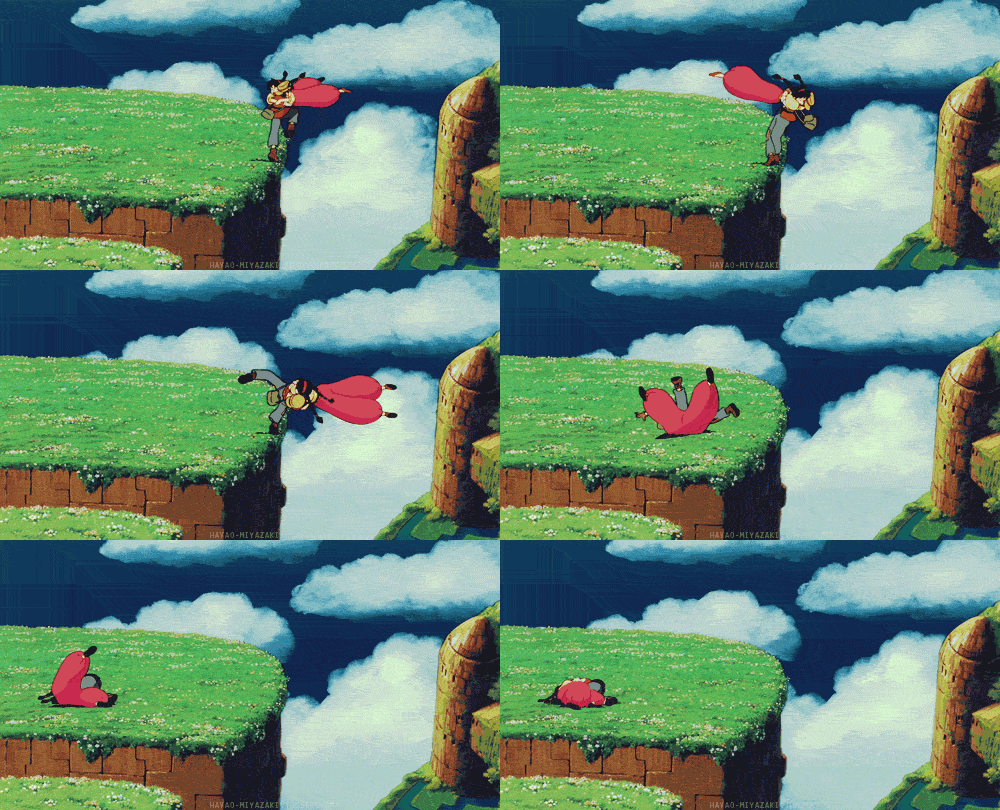
Just be careful you don't fall off. - from Castle In The Sky

Thursday, December 13, 2018

OSR: Three Monsters Ripped From - I Mean, Uh, Based On Battle Brothers


Battle Brothers is a hell of a game. I could go on and on about why I love it, but one thing that's stood out to me since the first time I sat down to play it is the enemy design. The basic enemies your mercenary company faces off against tend to be rather similar at first glance: brigands, orcs, goblins, and undead. But the game does a great job at making all its enemies feel different, escaping the trap many RPGs fall into, where any of those four are little more than 1 HD monsters with different aesthetics and equipment.

The game's main menu screen - by Paul Taaks

The game's two expansions – one free, one paid – mostly focus on adding new enemies to the roster. They're all good, if almost all more dangerous than the base game's enemies, and in some cases a bit cliche (trolls are tough and regenerate health but are dumb and cowardly, witches are weak as hell but screw with your guys by charming them and making attacks against them also damage one of your mercenaries). But the ones that aren't cliche? Oh, baby. They're amazing concepts.

Kind of. The monsters are cool, but since Battle Brothers is mostly about taking on a contract, killing some bad guys, going to a town to spend your coin on supplies, gear, and wages, then repeating it all over again, there's not a whole lot there for roleplaying, aside from some well-written but short and often choiceless random encounters. So while the enemies I'm listing below are based on the game, they aren't shot for shot recreations. I've taken some artistic liberties to make them more interesting and suited for RPGs than they already are. I'll have some notes at the end on what I changed.

Lindwurms
At first glance, these guys aren't that special. They're dragons. Tough armour, deadly attacks, even a hoard of collected treasure. But while they don't have flight and burning breath, they have something more unique: burrowing and rust-causing blood.

A Lindwurm - Paul Taaks

Lindwurms have a long, snaking body that shifts into a giant tail and two powerful limbs, covered in green, shining scales. Their arm-leg things can pull them across the ground at impressive speeds, but they mostly use this strength to dig. In just a few moments a Lindwurm can dig underneath the earth, moving underground and leaving a trail of upturned earth like the Graboids from Tremors. While they need to come up for air and aren't as smart as "true" dragons, Lindwurms are bright enough to exploit their movement. They love to burrow underneath forests, hedges, and walls in order to hinder those who would pursue them as they flee.

What makes them especially deadly to those who would hunt them is their blood. It's a powerful rusting agent, designed to blunt the edges of metal without destroying it, to better let them digest it. Oh yeah, I forgot to mention, they eat metal. While they can secrete it slowly from their mouth, the agent is also used in defense, Xenomorph style. Thankfully, the rust is only skin deep. A vigorous scrub will remove the top layer, leaving the metal beneath actually sharper than before. But by blunting edged weapons and coating armour in a heavy layer of rust – like wearing waterlogged clothes – Lindwurms reduce the effectiveness of their foes after every attack made against them.
 
LINDWURM
HD 6 (30 HP, 15 Attack, 10 Save)
Wants To eat any metal it can find
Armour As chain (scales)
Move 2x crawl, 1x burrow (for up to three rounds between breaths)
Morale 7
Attacks Bite: D6+3, Melee
Tail Swipe: D6-1, Reach, against up to three adjacent targets

A serpent as wide as a cart and as long as a ship, with two powerful limbs at the front of its body and none at the back. As it moves, its green scales glitter in the sunlight, and even in darkness the slightest amount of light creates shimmers and rainbows. When it digs it kicks up copious amounts of loam, creates an obvious disturbance above its location, and causes the ground to rumble and shake. Its maw opens wide to reveals rows upon rows of sharp teeth, and when cut its blood is a vibrant yellow green, which glows with unnatural light.

A Lindwurm's blood rusts metal. Non-blunt metal weapons that deal damage reduce their damage rolls by 1 until cleaned, and every time an attacker lands a non-blunt attack at Melee range, their armour's granted defense is reduced by one step until cleaned.

Anyone with a basic familiarity with the legends of lands where Lindwurms are found, or monsterology as a whole, will know that Lindwurms eat metal. They'll also know that metals like gold and silver are resistant to their rusting, letting them linger in their stomachs for decades. Cutting open a Lindwurm will reveal D100 times D100 cash worth of gold, silver, and jewels (they'll happily eat shiny stones, thinking they're metals).

Alps
Nightmare-inducing psychic vampires from another reality. They cause and feed on nightmares, sneaking into settlements and causing the inhabitants to suffer restless nights for months on end until they die of sleep deprivation or psychic harm. In a stand-up fight, Alps are hardly a threat. But they don't take stand-up fights. In dangerous situations, they can induce sleep in targets who fail a Save, and even target multiple adjacent creatures.

Sleeeeep... - Paul Taaks

Once someone is asleep, an Alp can induce nightmares, draining their health every round and healing the Alp in kind. For Alps aren't creatures of flesh and blood. They have eye sockets but no eyes, mouths and teeth but no digestive tract. Their white, smooth flesh has no bones or blood beneath it, and slicing them open reveals that their skin is as thin as paper. They can't see through walls, but they can sense the presence of anything with a soul, and see despite having no external eyes. (They have one inside their skull.) An Alp is a creature not just related to nightmares – it is a nightmare, and is as much defeated by strong arm and sharp steel as it is by courage and willpower.

What makes Alps truly insidious, however, is how they enter and exit our world. Guilt and fear draw them like moths to a flame, and the truly guilty are bright enough to pull Alps from whatever world they come from into ours. As long as the "lantern" burns an Alp can fade out of our reality, and always threatens to bring more back with it. The only way to stop them from fleeing the moment they're threatened is to remove the source of the guilt.

This guilt, however, is self-determined. They are as likely to be drawn to a murderer as they are to someone in the midst of a religious crisis, and the guilty naturally try to hide their guilt, or don't even recognize it as the cause of the town's nightmares. Even if you can track down the offending party, it's not always so easy to stop them. Not everyone is a murderer you can kill with impunity – sometimes, the guilty party is well-protected, or more often, a sympathetic character the party will want to help through their self-doubt.

And while the party works towards this, the Alps will fight them at every turn. In the night, they will attack the party directly, and when that fails they will send the lantern nightmares designed to exploit their underlying anxiety. They will kill pillars of the community to rile the people up into witch-burning mobs. They will make their nightmares seem to point towards a false source, like a nearby crypt full of undead. They will never let you get a restful sleep.

ALP
HD 2 (10 HP, 11 Attack, 6 Save)
Wants To feed on nightmares, to keep their "guilty lantern" alive and tormented
Armour None
Move 1x crawl, they can crawl up walls like spiders
Morale 3
Attacks Bite: D6-1, Melee, but they only use it if cornered

Humanoid creatures that crawl like a spider, with smooth, ghostly pale skin and empty eye sockets. Their mouths pull back to reveal grinning yellow teeth and bright red gums, and their heads are covered in strange protrusions, like horns and tusks made of flesh. They move as if they had no weight, and when struck by your weapons feel as though they are much lighter and softer than they should be.

An Alp can cause a creature within Near distance, and anyone directly adjacent to it, to Save or fall asleep. Lots of things can wake people up, but spending a round hooting and hollering will wake up anyone within Reach distance, as will any physical harm.

An Alp can cause a sleeping creature to suffer nightmares, dealing D6+1 AP damage every round until the creature wakes. The Alp heals that much damage in kind.

An Alp can fade out of our reality at will. This takes an action and renders the Alp incorporeal until the end of the round, at which point it leaves our world entirely. Alps ignore all physical damage from non-magic, non-silver weapons while incorporeal. If an Alp leaves our reality, it can only return if their guilty lantern still "burns".

Nachzehrers
I would have renamed these guys Ghouls, but I want to make my own version of ghouls, more peaceful ones based on Lovecraft's stories. That, and/or a tougher, more feral ghoul based on the one from Darkest Dungeon. In Battle Brothers these guys were originally called Ghouls before being renamed to Nachzehrers, a name which helps sets them apart and reinforce the game's Germanic setting.

Nachzehrers of increasing size - Paul Taaks

Nachzehrers are created from the corpses of those dead by suicide or accident. Anyone who is felled by their own hand has the potential to become one, although suicide with a concrete purpose, such as self-sacrifice or for honour, tends to prevent them from forming.

Such deaths are far from normal, and not every death results in a Nachzehrer. What makes them so common (at least as far as monsters go) is their ability to make more of themselves. Nachzehrers consume humanoid corpses wherever they can find them, digging up graveyards and attacking peasants and other weak sophonts – creatures with the intelligence and free will of a man – opportunistically. They can devour a corpse in seconds, gorging themselves on the flesh.

As they feed on corpses they grow in size and strength until they can swallow men whole. When they sleep in this bloated state their flesh splits and rends, turning one into two, or even four for the largest ones. In this way a single suicide can quickly spiral out of control, upturning their graveyard before spilling into the countryside in a growing pack.

Nachzehrers have grey, mottled skin, slavering maws full of jagged teeth, and scattered patches of dark black hair. As they consume more corpses they become larger, stronger, and grow spiraling horns, sharper teeth, and more and thicker hair.

NACHZEHRER
HD varies; usually starts at 1 (5 HP, 10 Attack, 5 Save)
Wants To eat the corpses of intelligent creatures
Armour None
Move 1x scurry
Morale 5
Attacks Claw: D6, Melee, +1 damage at 2 HD, +2 at 4 HD

Hunched over, bestial humanoids who move on all fours. Their grey skin is covered in bumps and patches of dark black hair. Each hand ends in sharp claws, uncannily similar to rows of fangs that fill their drooling mouths. When they howl it sounds like a man's imitation of a howl, or perhaps just a pained scream. The largest ones are covered in layers of fat, and have sharp, spiralling horns rising out from their foreheads.

Nachzehrers can eat the corpses of sophonts as well as other Nachzehrers. This takes an action and causes them to grow one size at the end of the round, from 1 HD to 2, and then from 2 to 4. When they grow their current HP is raised to their new maximum, and their Attack and Save are also raised.

A 4 HD Nachzehrer is too full to eat corpses, but is so large it can eat a human. They can swallow a creature within Melee range if they fail a Strength test, dealing D6 AP damage every round until the Nachzehrer is killed. On the plus side, when they are killed, their bloated bodies "pop", freeing the trapped creature without having to cut them free.

So what did I change?
Lindwurms in BB have the acid blood and digested treasure, but not the burrowing. I honestly thought they burrowed, but since they're a rare enemy and one I don't normally like to fight I just don't see them often enough to remember they don't until after I started writing.

Alps are more or less unchanged except for the bit about being attracted to guilt. They also get a damage resistance buff for "existing partly in dreams" which gets stronger the more of your mercenaries are asleep, but that was too finicky for RPG combat so I made them able to escape reality entirely. After that I thought "well what's stopping them from just fleeing and returning endlessly", so I added the guilt attraction so that there's a way to banish them.

Nachzehrers are unchanged. The game implies that big ones become lots of smaller ones, and makes it unclear whether or not they're naturally occurring or the product of suicides, so all I did was clarify it.