Showing posts with label classes. Show all posts

Thursday, February 14, 2019

Into The Void: Starships for Into The Odd

Starships are characters. Anyone who enjoys a lot of sci-fi can tell you every good starship has its own feel. Unfortunately, most RPG rulesets make ship-building, well, ship building. This is fine when you're playing a game like Traveller where there is a certain degree of realism as a design goal, but for most OSR games, the idea of building a character is anathema. And if ships are characters, ship building should be anathema too.

Now, the reason games tend to let PCs build their ships is because a ship is, after all, an object and not a person. With the exception of transhuman settings, a PC born with 3D6 in every stat very plausibly has no ability to change them except through leveling up, and maybe not even then. A ship, on the other hand, is built to exacting specifications. It's realistic that PCs have random stats – but it's also realistic that ships have chosen stats.

But is buying a ship really so common in sci-fi? And are bought ships really bought to specific taste? The first time the Millenium Falcon shows up in Star Wars, it's meant to be underwhelming. The Rocinante from The Expanse is a top-of-the-line Martian stealth ship, but not only is it stolen, it's stolen thanks to a combination of luck and desperation. Its crew didn't choose it.


Does this really look like anyone's first choice of starship?

When ships aren't beat-up, they tend to be the military cruisers of Star Trek or (again) Star Wars, or the realistic science ships of Interstellar or 2001. These are not the kind of ships that plucky adventurers acquire. Furthermore, bought ships are often bought on the cheap, from second-hand or unscrupulous dealers.

So. When the PCs get their hands on a ship, there is a good chance they will not get to decide what is and isn't on it. They're not in much of a position to argue. But a ship is still easily upgraded once you've got one – after all, it is a machine. I think this is why most games will let the players design their ships. But why not randomize their creation, and let them upgrade it as they see fit afterwards?

Into The Void
This assumes you've read Into The Odd by Chris McDowell before. It's a quick read with good ideas. If you haven't/won't/don't have the time here's the rundown: three stats, roll equal or under to pass tests, attacks automatically deal damage (but don't automatically "hit" per se – this goes into more detail), there are no classes or races, and magic is handled through magic items rather than learned spells. Personally, I think this fits sci-fi a lot more than it fits fantasy.

Bastionland, the in-development setting book for Into The Odd, starts every game off by having the PCs in monumental debt, and they start adventuring to pay it off. This fits sci-fi games well. A ship costs 100G to purchase, but the PCs start with one anyway, but they owe 1G per month to their debtholders until the debt is paid off. Running away to the rimworlds or beyond is a totally valid strategy, but bountyhunting is a common profession, and debtholders will double the price of the debt owed if you willingly dodge paying.

STATS
Starships have four stats, rolled 3D6 in order. When you roll for Shields, write down the results of the individual D6s - they'll be used later to generate ship quirks.

Hull (HUL) is their structural integrity, resiliency, redundancy, and general stability. You test Hull to crash safely, smash through things, and resist Critical Damage.

Engines (ENG) is their speed, mobility, agility, acceleration, and general movement. You test Engines to outrun enemies, dodge obstacles, and perform tricky maneuvers.

Systems (SYS) is their hardware and software systems, sensors, and general intelligence. You test Systems to scan things, resist hacking attempts, and run computer programs.

Shields serve as a ship's HP. They're never tested but they're used to resist damage, and recharge if the ship is given time to do so.

FUEL AND TRAVEL
Default ships have 4 Max Fuel capacity and start with a full tank. Fuel costs 1G and can only be purchased from well-equipped starbases and fuel refineries.

Things like moving between planets, dogfighting, maneuvering past obstacles, etc, don't cost any Fuel. The same "gravdrive" which provides a ship's artificial gravity is also used to move the ship through space, applying gravitational force to it and dragging it from location to location. Making course corrections requires a pilot.

Interstellar travel costs 1 Fuel per week of travel, and it takes a week to go from one hex to another (which in most games will be the equivalent of 1 light year). The ship's "hyperdrive" pushes the ship out of our dimension - Realspace - and into a higher dimension - Hyperspace - where the distances between locations are smaller and ships can travel faster. A ship can only enter Hyperspace safely if it is outside the gravity well of a planet.

Taking off from a planet takes an amount of Fuel based on the planet's gravity. Standard gravity worlds require 1 Fuel, while high gravity ones require 2 and low gravity ones don't require any. It doesn't cost any Fuel to land on a planet safely.

LIFE SUPPORT
A ship can support a number of people equal to its SYS + 2 indefinitely. Food, air, and water are all recycled although eventually the crew will be eating nutrient paste. This can last a ship for months, years if carefully rationed, and a ship's stores can be replenished easily on any habitable world. Standard life support systems have backup generators that allow them to run even if the ship's reactor is disabled or destroyed.

If Life Support is damaged or the crew reroutes the backup power to other systems, they have supplies left for one week per person the ship would normally be able to support. Ships with crews smaller than their capacity can go longer without life support being online.


Hydroponics by Eddie Mendoza

COMBAT AND DAMAGE
Ships start with standard weaponry (D6 Damage) and no armour (0 Armour).

In combat, attacks land automatically, but the damage is reduced by a ship's Armour. A ship's Shields absorb damage until they run out and damage starts being dealt to the ship's HUL instead. Shields recharge to full if the ship goes for ten minutes with its power running but without doing anything of note – remember that objects maintain their momentum in space, so you can keep it moving while doing so. Firing a ship's weapons requires a gunner.

Each time a ship takes HUL damage, they have to make a HUL test with their new HUL. If they fail this roll, the ship isn't taken out of combat, but instead the party must roll a D12 on the table below. The system listed is disabled and the consequences are listed beside it.

1 Jumpdrive: The ship cannot travel through Hyperspace and therefore between stars.
2 Gravdrive: The ship loses gravity and the ability to move at more than a snail's pace.
3 Targeting: All weapon attacks are Impaired and require manual aiming.
4 Fuel Pods: The ship loses half its Max Fuel, and any Fuel over the new maximum.
5 Sensors: Aside from what you can see out of the windows, you're flying blind.
6 Life Support: The ship has one week of supplies left for each point of SYS, plus two.
7 Shields: The ship's shields are reduced to 0 and will no longer recharge.
8 Bridge: Everyone in the bridge must test STR or suffer Critical Damage.
9 Cargo: Everything in the cargo bay is shunted out into space.
10 Quarters: Everyone in their quarters must test STR or suffer Critical Damage.
11 Computer: Everything in the ship must be done manually. The PA system is offline.
12 Reactor: Everything except for life support is deactivated.

If a ship hits 0 HUL, it is only a matter of time before it is destroyed. Roll a D6. In that many rounds, the ship's core will go nova, exploding the ship, killing everyone still on board, and rendering it little more than scrap metal. As long as the ship's computers aren't disabled, the time left will be loudly declared at the start of each round. Moving from one section to the ship to another, getting into and launching a lifepod, putting on a vaccsuit, and exiting the ship via an airlock all take one round each.

Repairing a ship's HUL requires a week of repairs in a starbase and 1G per HUL repaired. Repairing a subsystem also requires 1G. You can perform repairs outside of a starbase, but this will also take a week and will require cannibalizing parts from other systems, ships, or even the ship's maximum HUL score.

GENERATING SHIP QUIRKS
Remember when I told you to write down the individual D6 rolls for Shields? This is why. The result from each D6 gives the ship a quirk, with higher numbers having worse results. The higher your Shields are, the more negative quirks the ship will have, but the lower they are, the more positive ones they'll have. This fits in nicely with Into The Odd's system of giving PCs with low stats better starting gear.

6 Absent Weapons: This ship starts with no weaponry installed.
5 Flickering Shields: If an attack against this ship deals max damage, it bypasses Shields and directly damages HUL.
4 Cracked Hull: -1 Max HUL. There's a huge gash in the side of the ship.
3 Thick Hull: +1 Max HUL, -1 Max ENG. The ship has a much thicker hull than normal.
2 Armour Plating: The ship's Armour is increased to 1.
1 Reinforced Bulkheads: +2 Max HUL. The ship's internal walls are made of a strong alloy and the doors are difficult to force open. Boarding it is a tactical nightmare.

6 Faulty Jumpdrive: After exiting hyperspace, the ship's reactor is disabled for D6 times ten minutes. This leaves only life support and door controls online.
5 Missing Fuel Pods: -2 Max Fuel.
4 Laggy Gravdrive: -1 Max ENG. The ship moves a few moments after it's told to.
3 Huge Drives: +1 Max ENG, -1 Max SYS. The jump- and gravdrives are oversized.
2 Antigravity Plating: It costs 1 less Fuel to take off from a planet's gravity well.
1 Cloaking Device: The ship has a cloaking device onboard, which can be activated to turn all systems offline, but make the ship undetectable to all but the strongest scans.

6 Adware Beacon: The ship constantly and loudly broadcasts advertisements.
5 Eccentric Systems: The cost of all upgrades on this ship are increased by 10%.
4 Computer Glitches: -1 Max SYS. Computers are always messing up slightly.
3 Redundant Systems: +1 Max SYS, -1 Max HUL. There's two of every subsystem.
2 Intelligent Ship: The ship has an agreeable AI controlling it. They have 9 + D6 CHA, no STR or DEX, and can perform one task a PC would normally have to do per round.
1 Payment Error: The ship's total debt or cost is reduced by 25G, once. If stealing or salvaging a ship this quirk is meaningless.

It costs 10G and a week of work to remove a negative quirk. For the ones with positive and negatives, only the negative part is removed.

UPGRADING SHIPS
The rules above should do a good job at generating patchwork ships to start off the party. Buying better ships once the PCs hit it rich is beyond the scope of these rules. However, by the time a party can afford it, cost shouldn't be a problem unless they want a ship to have 18 in every stat and tons of upgrades. Either their wealth can buy it easily or their demands are so high it's beyond their reach and should be acquired through an adventure, if at all.

But what about upgrading a ship? Fixing the problems of a ship are, in a way, just another kind of upgrade. It's not too hard to extrapolate fixing the fuel pods into adding more.
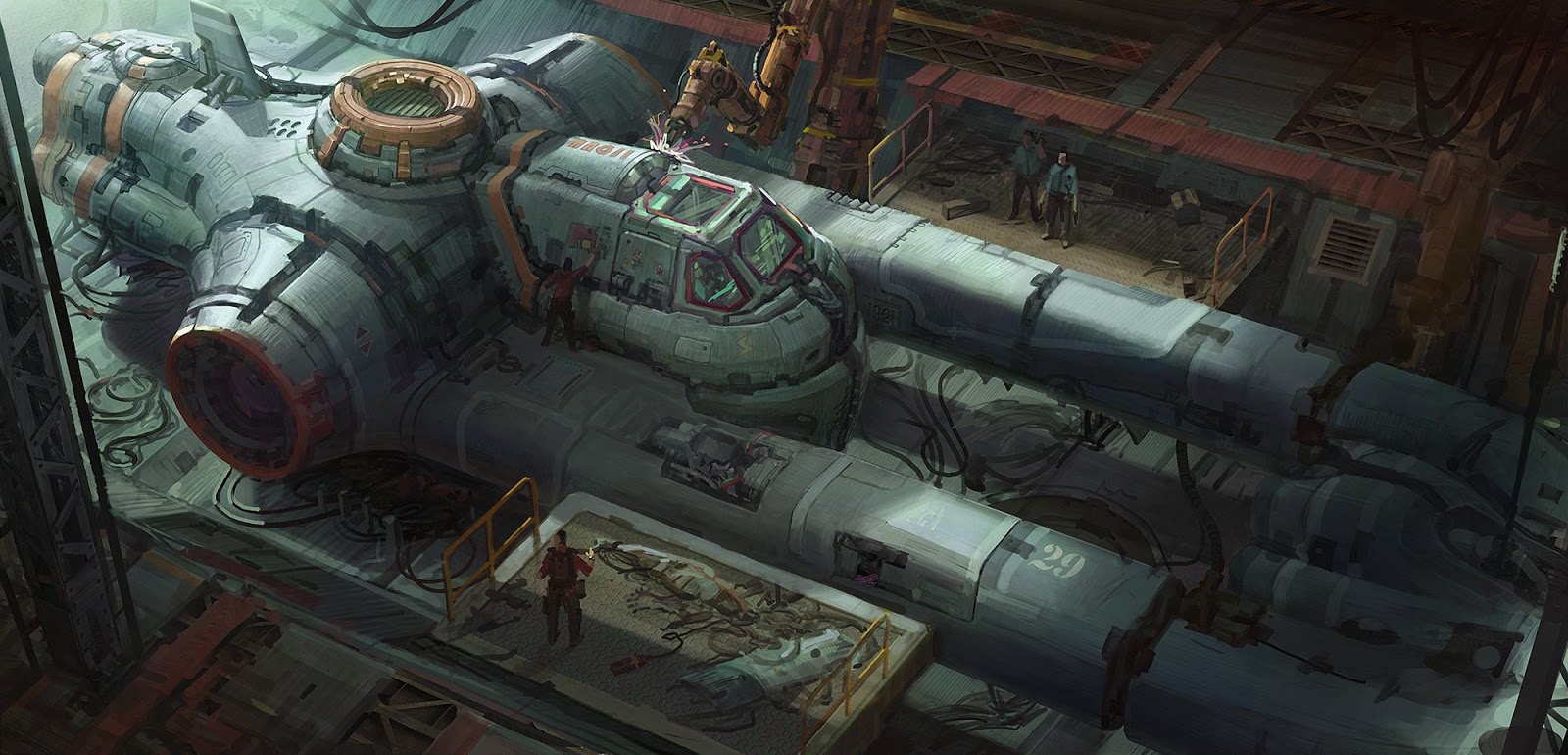

Ship Repairs by Mark Zhang

There are two kinds of upgrades: stat upgrades and subsystem upgrades. Stat upgrades simply raise one of the ship's four stats by one to a maximum of 18. The first time a stat is upgraded it costs 10G, the second time 20G, the third 30G, and so on until it reaches a cost of 100G at which point it doesn't increase any more.

Subsystem upgrades instead add a new subsystem to the ship, giving it more potential or increasing the efficiency of existing systems. A ship can have as many upgrades installed as it has points of SYS. A list of example upgrades is given below. Upgrades with asterisks next to them can be taken more than once, up to a number of extra times equal to the asterisks there (so two asterisks mean an upgrade can be taken three times).

These should all cost 10G, but they are by no means the only upgrades out there, nor is 10G the set cost in every system. There may be better subsystems available for steeper prices, or which can only be acquired through salvaging alien/ancient/ancient alien technology. And of course, not every starbase will be able to sell you every upgrade.

BASIC SUBSYSTEMS
Advanced Weapons**: Increase the ship's damage die one step. D6 > D8 > D10 > D12.

Armour*: Increases the ship's armour by 1. 0 > 1 > 2.

Fuel Pods*: Increases the ship's Max Fuel by 2. 4 > 6 > 8.

Hydroponics: A large room sized garden. Doubles the ship's life support capacity.

Smuggler's Hold: The ship has a small, hidden cargo hold that can hide a few crates or few people from most inspections. You can use this space to found an Enterprise aboard your ship, but it only gains both income and losses while in systems that buy contraband.

Cargo Bay: The ship's cargo bay is expanded and can hold lots of material including a few vehicles. You can use this space to found an Enterprise aboard your ship, but it only gains both income and losses while in systems that buy bulk supplies.

Rec Room: A comfortable room with a nice TV, gaming systems, VR equipment, bar, kitchen, and other assorted luxuries. Lets you restore CHA after a day of relaxing.

Medical Bay: A sterile room with comfortable beds, an autodoc chamber, and all the gear you need to perform surgeries, diagnostics, autopsies, and more. Lets you safely treat Critical Damage and restore STR and DEX after a day of treatment.

Fuel Scoop: If you spend a week in a gas giant's atmosphere, you can harvest 1 Fuel at the cost of D6 HUL. This HUL damage does not cause Critical Damage or reduce a ship below 1 HUL, but if the damage would have reduced it to below 0 HUL, the ship doesn't gain any Fuel. (If it kept scooping Fuel up, it would be reduced to 0 HUL and destroyed.)

Shuttle Bay: Stores a small shuttle that can carry a small cargo or six passengers or mixture of the two, as well as a pilot and copilot either way. The shuttle is slower than any ship but can easily leave a planet's surface for its orbit in half an hour and for no Fuel cost.

Advanced Jumpdrive*: Upgrade the ship's Jumpdrive so that interstellar travel is either cheaper or faster. When setting out into Hyperspace, decide between using half as much Fuel, rounded up, or taking half as many days, rounded up. Taking this upgrade twice lets you do both.

Lifepods*: One person pods that can be deployed to escape a ship in one round. Comes with as many lifepods as the ship has SYS + 2. When taken twice it both doubles the effective amount and lets you have them be located at two locations on the ship.

Laboratory: Used to perform research, analysis, and other similar studies.

Sensor Suite: Greatly upgrades both the range and information granted by your sensors.

Cloak: Allows the ship to "go dark", unable to do anything but undetectable while doing so.

Tractor Beam: Allows the ship to move shuttle-sized and smaller objects that are within weapon range. Ships may make a test with the lower of STR and ENG to break free.

Workshop: Used to perform modifications, repairs, and upgrades on vehicles and robots.

Probe Bay: Stores up to four probes which can operate autonomously or by manual controls and transmit and receive information on the other side of a system. Replacing a drone costs 1G. Each drone is twice the size of a man and has a panoply of sensors, manipulating limbs, and moves via artificial gravity. They can reach orbit in a few hours.


These probes are the ones from Star Wars, more or less. Art by Slayerlane

Shrine: By virtue of divine blessing or being in the right place to get in the way of damage (crews can never agree on which), this system allows the ship to reroll a disabled system roll and take the new result even if it is less desirable or the same result.

Cryopods*: Allows you to store SYS + 2 people in cryostasis. They don't age, die from injuries, or suffer harm from poisons or diseases, but they still count against the ship's life support. Most starship passengers prefer to be in cryosleep on the trip.

Vault: A secure location deep inside the ship but designed to easily detach. Contains a small, self-contained life support system with an airlock. A vault can survive most attacks and even a ship going nova, keeping up to twenty people or a moderate amount of cargo safe temporarily, or five people alive for months.

Intelligent Ship: An artificial intelligence installed on the ship's databanks and capable of running one system as well as a trained human would at a time. The AI always starts loyal and has 9 + D6 CHA, but no STR or DEX. You can download them into a robot body to turn them into a PC, but if you do so, they will not be able to be turned back into a ship.

Shipskin Projector: A translucent pink wall of a rubber-like organic substance, one side inside the ship, the other exposed to the void of space. Passing out of the ship through the projector coats organic creatures in the "shipskin", which serves as a comfortable and self-healing vaccsuit with a few hours of oxygen.

Wednesday, January 16, 2019

Platonic Race-As-Class

Race-as-class is an idea that, in theory, works. It allows a setting to have truly alien races by making the way they play fundamentally different from human classes. It also allows races to have impressive powers while keeping them balanced, since their strength is offset by the fact they lack the cool class powers humans get.

In practice, I've had bad experiences with it. Players avoid it, and when they don't, they make every Dwarf Gimli and every Elf Legolas. And almost inevitably, someone will ask if they can play a Halfling Fighter or Dwarven Magician and I'll have to tell them no.

There is a ethos found in many OSR games that pushes away from the highly customizable characters of modern D&D and D&D derivatives, preferring instead to focus on making the characters different through how they're played and what happens to them during the course of their adventures. I'm all for this (in certain games - I enjoy the customization inherent to the playbooks of Apocalypse World variants, but get why that doesn't work in an OSR game), but I feel like race-as-class hinders, not helps, this idea. When every fighter is the same, you start to try to set them apart from each other. But when every dwarf or elf is the same... you start to play them like a stereotype, since everyone has an image of what a dwarf or elf "should" be.

Secondly, there is also a push towards verisimilitude in OSR games. Again, I agree with this (and again, see where it's better to focus on an interesting story over what feels "real"), but then a part of me starts wondering why only humans and elves can learn spells. Why can't a dwarf start studying magic? Or why can't an elf or dwarf of halfling be a specialist and learn any number of skills which, in theory, you don't even need to be an adventurer to learn?


Part of my reason for feeling this way is spending a long time playing Dwarf Fortress over the years. The eponymous dwarves in your eponymous fortress all have different jobs and personalities, and yet when you run into elves or humans or goblins, it's clear that a dwarven engraver is different from an elven engraver. Art by RaysinMocona.

So here's my idea: each "human" class has a certain part of it that is not strictly necessary for the class to function and can be removed. Furthermore, each race-as-class has a certain part of it that is inherent to the race, but is also not so strong that it warrants being part of its own class.

If you want to play a race as a class you can do that. An elf is an Elf, a dwarf is a Dwarf, a halfling is a Halfling. But if you want, you can play a Fighter who's also an elf, or a Specialist who's also a dwarf, or a Magician who's also a halfling. (Note the use and disuse of capitalization - the difference between a race, and a race-as-class.)

To do so, you remove the unnecessary part of the human class, and replace it with the inherent part of the nonhuman class. So your magician doesn't have cantrips anymore but now they can see in the dark. Your specialist no longer deals sneak attack damage but now they're impossible to surprise.

This also makes it easy to make new races and classes who work. Each time you make one all you need to do is find one part of them that fits the mould and you have guaranteed compatibility with any other class and race you make.

Give me something I can use you nerd!
Okay, okay, fine. Some of these may seem complicated but once you figure out what a class in your system should have removed you're set for life.

I want to play a...
Fighter...
Remove any bonus HP (e.g. move their Hit Die down to the average).

Specialist...
Halve the number of skill points gained at level one. If not using skill points, remove any sneak attack damage bonuses and/or the ability to gain them.

Magician...
Remove any cantrips. If you don't have cantrips, -1 cast per day unless you only have one cast per day at level one or don't have casts per day, in which case reduce the number of known starting spells to one. If you're outside that you're probably using a homebrew in which case you know more about the class than I do. Make up your own removal.

Cleric...
Remove any bonus HP, if they don't have bonus HP remove the ability to dispel magic, if not that their ability to turn enemies, if not that reduce their spells like a Magician.

...who's also a(n)...
...Elf!
Automatically pass test of initiative/any other reaction-based bonuses.

...Dwarf!
Can see in the dark or just better in dim light (either way the better-sight-in-darkness stuff).

...Halfling!
You can heal from eating any number of times per day or you're good at hiding behind stuff.

...Orc!
+1 HP per level or step your Hit Die up one step (whichever you prefer).

...Fishman!
You can breathe underwater.

I've never seen an Orc or Fishman class before.
I got you good, didn't I!

The beauty of this is you don't have to make a race an entire class. I've never had an Orc or Fishman class in any of my games (yet) and I'm willing to bet most people haven't either. But with a single line of writing - one stolen from the Fighter class, the other the most obvious racial bonus in existence - I just made one.

Furthermore, that Orc bonus implies an Orc class is just a Fighter with green skin. Which I think is awesome! You could spin a Cleric into being an Angel or a Specialist into being a Ratman. Then just take a key part (probably not the same one that was removed - a Cleric's extra HP doesn't really say "Cleric" to me) and you can turn them into an Angelic Magician or Ratman Fighter.

But wait, there's more! What makes an elf an Elf? Fighting + magic? And what makes a dwarf a Dwarf? Spelunking focused stuff? Why not make a Human Dwarf or Halfling Elf! Replace the Dwarf's darksight with +1 HP/level or +1 HD size (humans are durable), and the Elf's initiative with a Halfling's eating or sneakiness.


Geralt (like all witchers) casts spells and stabs people. He even has sensory abilities. Sounds like an Elf to me! Art by Zary.

Not only does this system make it easy to play a Dwarven Fighter or Elven Specialist, it makes it easy to play more unusual takes on existing classes. All of a sudden, a Dwarf isn't the only type of dwarf you can play - and, when you play a Dwarf, you don't even have to be playing an actual dwarf! What was once a restricting system is now an open encouragement to be creative, while at the same time being simple enough in structure that players aren't bogged down with choice.

Where to go from here:
Joseph Manola's neat B/X D&D classes. He's written a lot of cool classes but you can mine this file for ideas/usable ones without diving into his blog (but you should do that anyway because it's neat). Even has an Orc and Fishman class!

Joe Fatula's take on fantasy races. These are very interesting just in general but also play with idea of races being based on but not strictly bound to a stereotype - adventurous humans, haughty elves, etc etc.

Emmy Allen's Miner and Lantern-Girl classes. It's easy to see how a Miner is just a human Dwarf and a Lantern-Girl/Link-Boy is a human Halfling, and easy to see how you could easy run them as just a Dwarf or Halfling. The Miner is the class that inspired me to write this post in the first place.

Monday, December 17, 2018

Mothership: Two Creatures, a Class, an NPC, a Goddess, and a Flying City

Here's some more stuff for Mothership. However, aside from the Innocent (which is really just a character archetype), you could use most of this in any system and setting.

Garuda
Named for the legendary mount of the Hindu god Vishnu, Garuda are genetically engineered birds with internal antigravity plates, designed to carry passengers as they fly.

By Moebius

The largest birds in Earth's history had wingspans of around twenty four feet, around seven and a third metres. The largest living ones are albatrosses, with wingspans of eleven and a half (three and two thirds). On alien worlds, with denser atmospheres and lower gravities, the largest wingspan yet found is the thirty feet of M. lindberghii, native to the Company colony of New Kinshasa.

But even on these low gravity worlds, the dream of the flying mount was just a dream, and nothing more. Until Company analysts started to send surveys to the rich and powerful. It was slow going at first – advertisements are for the unwashed masses, after all – but once they started getting responses, the idea was floated and positively received.

Each Garuda is more wing than body, and their brains are simple, unable to do anything but fly at their jockey's command. Garuda "feed" on a high energy predigested slurry, which is pumped into their bodies by connecting a hose to the creepy metal nozzle they have in place of a throat. The slurry is filled with nutrients, energy, and oxygen, capable of sustaining them for days of flight and weeks of downtime between feedings. Their legs are merely vestigial, and they rest on rotund bellies softened with fat not for their comfort but for their rider's, so that landings are cushioned.

By James Gurney

You might be thinking: "Hey, I know this is scifi, but how on earth were they able to design a flying mount?" Well, that's because their designers cheated. Every Garuda is filled with artificial gravity plates. The smallest models might have a single one just to keep them afloat, but larger types have several, as much an agrav* with an organic shell as they are an actual animal. They are still propelled by muscle, of course, but pedants are quick to complain that you might as well cover an agrav with feathers and say it's a beast as well.

The smallest Garuda are designed to carry a single rider and little else. The largest, often referred to as "sky-whales", have multiple sets of wings and entire rooms built on their backs and bellies, or even into their bodies. The newest "Leviathan" models have a single spiral staircase that can take you from a viewing dome on the top to another on the bottom in less than a minute of walking.

While initially designed and mostly made for luxury purposes, Garuda have found some limited use in search and rescue, exploration, and military roles. Their use of agrav plates doesn't require that they hold up the full weight of what they carry, and as they are mostly organic, the weight they do have to support is much less than that of a metal vehicle. On worlds where supply lines are non-existent, such as backwater colonies or uncharted systems, the expense of a Garuda can be worth taking one in place of an agrav. In terms of weight, carrying slurry tanks is more efficient than carrying fuel or batteries, making them well suited to situations where recharging from a generator is not a reliable option.

*An agrav is a vehicle which makes use of antigravity or artificial gravity plating to fly. Some ground vehicles or conventional planes and helicopters use agrav plates to support themselves, but an agrav vehicle is one that is fully dependent on their use.

Muninn
Intelligent – though only protosapient – crows with recording and tracking devices embedded into their bodies, as well as chameleonine feathers and the ability to speak and even hold simple conversations. They are named for one of the two ravens of the Norse god Odin, who were said to fly across the world at dawn each day, returning to the god at dinner to recite what they had learned in their travels.

By Darko Tomic

Their species implies their most common use, which is to hunt, tracking quarry via a "third eye" camera set between their two true ones. It can show them images in infrared, light amplified, and just generally magnified forms. Most of their extra brainpower is devoted to understanding the nature of tracking, to be able to predict where a target will go even when they can't see them.

A Muninn's feathers are capable of changing colour like a chameleon's scales. They use this ability mostly at a distance, blending in with the sky before shifting to a normal colour when they perch alongside other birds. Crows are among the most common Earth transplant species in the human sphere, ensuring they blend in on most planets. For those worlds where they don't, specially made non-crow versions are available.

Because Muninn are, aside from their camera and brain augmentation, functionally identical to a crow, they are difficult creatures to track. In extreme situations such as after EMPs or when communications channels are being monitored or jammed, a Muninn can function without their implants or without radio connection. In fact, most Muninn "run dark" by default, only transmitting recorded information via a physical connection to prevent their communications from being tracked. Or just by talking. Did I mention they can talk?

Huginn and Muninn, Odin's raven scouts, were granted the ability to speak. The modern Muninn is no different. Talking pets have been around for centuries at this point, and the general agreement has been that anything that isn't an uplift – and therefore not a pet – is boring at best, unsettling at worst. Because speech is not typically necessary for animals, and is expensive and slow to augment into a creature, it is rarely granted. But Muninn can make use of it, both to transmit the information they've received and to carry messages of their own.

By Front 404

The supernatural elements of Mothership give hope that there may be psychics, souls, and even afterlives in the setting (there certainly are in mine), but at least in our reality, entropy always wins. If something can be spied on, it will be spied on. No defense is impenetrable, and so even the most secure lines of communication can be monitored, bugged, and recorded. Forget your enemies – the Company will gladly spy on anyone they think it could be worth watching.

Muninn help escape this problem. There's no phone to be bugged, no databank to steal and crack. The crows aren't intelligent enough to understand the messages they're carrying, or be bribed or tortured into revealing them, and, as of yet, the organic brain proves impossible to read via technology. (In those few places where psychics are starting to become exploited, animal brains are actually harder to read than human ones.) They can carry a message, unseen and unheard, and even elaborate on it. They can record a response and return to their owner with it. Due to their organic nature, they can even fly for days, weeks in some rare cases, to carry a message "as the crow flies".

A Muninn can be killed by a firm punch, but landing one is not easy. Hitting an unaware Muninn requires a normal Combat test, but hitting a Muninn that's actively moving requires a critical hit. Hitting an aware, flying Muninn at anything but the closest ranges is an exercise in futility, and requires a roll of exactly one. If you hit a Muninn, it has only 3 HP.

The Lady In White
A celebrity bodyguard for those in high society. No one knows what she looks like or even what she sounds like, as she always wears the same white bodysuit with a mask and voice scrambler. The only part of her anyone can see is her snow white hair, always worn in a bun. She favours close-range combat, and carries a katana, kris, and Scholz and Vogel "Fafnir" plasma pistol.

In addition to being a fashion statement, branding image, and easy way to stand out in do or die situations, the Lady's suit is also a highly advanced piece of armour. Despite being almost skintight and highly flexible, the suit has been shown to block bullets and blades in the several recorded fights she has been in. Her aversion to being hit indicates it isn't able to always block such strikes, but there are purchasable models of armour roughly comparable to what she wears. If you had millions of dollars to spare, at least.

Everything she wears, and every weapon she wields, is coated in a superthin layer of a highly hydrophobic substance. This gives it a brilliant sheen, but more notably causes blood to slip off of it in a few short seconds. By the time she sheathes her blades, they and her clothes are as white as they were before, leaving her immaculate and untouched.

The Lady has become notorious as a mysterious figure of uncanny grace. Clients hire her as much for her ample skill as for the status of being protected by her, and those who have the fortune of speaking to her describe her as cold, sarcastic, but ultimately an interesting person to talk to. But make no mistake: the Lady does what she does for the thrill of the fight, not for a place in high society. At the slightest sign of threat, she jumps from casual conversation to active combat in the blink of an eye, before returning without so much as acknowledging the combat once the all clear is sounded. Or not returning, if she was finding the conversation boring.

She prefers to take contracts she expects will have a high chance of seeing actual combat, and as a result tends to guard the kind of executive PCs will want to kill or manipulate. The Lady has developed a reputation as a duelist, challenging those who insult or rival her to legal duels, and offering herself as a champion to those challenged by someone or someone with a champion she wants to fight.

Combat 67%
Armour 3 or 2
Body 40%
Speed 50%
Instinct 33%
Health 60 or 15
Attacks Katana: 3D10 or D6+1, 2 Hands
Kris: 2D10 or D6, 1 Hand
Plasma Pistol: D100 or D6+2, Armour Piercing, Close range, 3 shots, 1 Hand
Special When the Lady in White would be brought to 0 HP or below, she instead remains at 1 HP, but is stunned for a round – she has never had her armour broken before, and so the feeling of blood seeping into her suit and sight of the growing red stain shocks her. If this happens again in the future, she will again be stunned, as she is not used to the pain.

A short, lithe woman in a white bodysuit with a featureless white mask and snow white hair tied in a bun. When she speaks, the voice is clearly not her own, and slowly morphs to another voice over the course of her conversation. She carries a sheathed katana, kris, and holstered plasma pistol, and walks and talks with the utmost grace.

The Innocent
Mothership is very clearly based on Alien and Aliens. There are other inspirations, and you could use the game to run a non-horror game just fine (although at that point it might be better to use a different system like Traveller or Stars Without Number), but it's the Alien series, and especially the original two, that seem to be the main source.

The classes in Mothership are Teamster, Scientist, Android, and Marine. The only one that doesn't have a clear inspiration in Alien or Aliens is the Scientist, and even then scientists practically dominate the rosters of later installations like Prometheus or Alien: Covenant.

But there's one classic character left out: Newt.

Isn't she adorable? - From Aliens

Not everyone in the depths of space is there to kill or be killed. Well, everyone can be killed, but not everyone signed up to do a risky job. Sometimes, people find themselves in the strangest situations through no fault of their own, or tag along on the journeys of others with no intention of taking part in the difficult work.

But they are far from useless. Their optimism and presence grounds those around them to their humanity, reminds them of what they have a chance to be a part of. When facing inhuman monsters and impossible odds, amorality and nihilism cling to humans like a disease. If you gaze into the abyss, the abyss gazes back – and with the number of monsters the average adventurer fights, it's all too easy to become one themselves.

And innocent does not mean incapable. Where other characters have strong weapons and sharp minds to protect them, the Innocent must stand against their foes alone. They have their friends for sure, but to stand alongside larger-than-life characters without running in fear requires even more courage than them. And because everyone gains the same skills and stats each level, the Innocent will eventually be as strong as their allies.

The Innocent are orphaned kids picked up from lost colonies and the significant others of crewmembers. They're therapists and priests. They're artists and philosophers and free thinkers. They're all the people we think are useless but couldn't do without. When a Marine takes a life, he does it to protect them – when a Scientist makes a breakthrough, her knowledge will improve their lives. We are what we fight for, and we fight for them.

Stats: +5 Speed, -5 Combat

Saves: 30 Sanity / 60 Fear / 20 Body / 30 Armour

Stress: Spend a round to calm someone down and let them reroll a Fear save or panic check.

Skills: Rimwise, +3 Points

The Goddess of Lost Things
In a setting with explicitly supernatural elements, however rare and unknown, religion is not something so easily shed. Most sci-fi settings tend to push it to the background, making characters with faith often zealots or aliens (or both).

But in the depths of space, society diverges from the norm. Lost colonies can go decades or even centuries before being recontacted, and in that time, a small initial population can rapidly expand. New religions develop, as do new takes on old ones. It's human nature to push the boundaries of what is normal, and a predominantly atheist or agnostic civilization will only have its religious members gravitate to the fringes, fringes where communication delays and unnatural living conditions promote new ways of thinking.

From Netrunner - by Yog Joshi (the art, not the game)

While all but the most ancient and venerable religions tend to stick to their systems of origin, one faith – if you can even call it one – has spread far and wide. The Goddess of Lost Things, patron of travellers, explorers, and refugees.

Her worship does not demand that she be praised before any other. Indeed, she has no priests or priestesses, no holy books or commandments. Her temples are hostels, her prayers meant to inspire hope, not devotion. Countless people who have no doubt that she does not exist pray to her all the same.

The Goddess of Lost Things is worshipped by those far away from home. Travellers and explorers, but also refugees and, naturally, the homeless. She requires nothing, but offers subtle intervention in return for prayer and sacrifice. Many who "worship" her are completely atheist, only making the prayers for their own comfort. Having something to have hope in, even if you know for certain it's unreal, can make all the difference.

Her favour is purported to come in many forms. Simple things like safe journeys and interesting expeditions, or large things such as finding new homes and escaping hostile pursuers. Her most ardent worshipers are not wanderers, but rather the once homeless or displaced who, after praying to her, found a way out of their situations and feel the need to repay her through continued worship.

While they are her most zealous followers, her most common ones are travellers. Deep space explorers, Company couriers, and interstellar haulers offer her prayers and build shrines on their ships. They hope for safe, quick travels, but more than that, the religion offers them something to focus on on the long journeys between the stars.

For those with more faith, the closest thing to a structured church she has are the Temples to Lost Things. They tend to be found in and around starports and other places where travellers congregate. Each is more or less a glorified hostel, run by those faithful in the Goddess and designed to be as cheap as possible. All profits are put back into funding the temple or towards charities that help the homeless and displaced – those in great need of shelter, like refugees or runaways, are often allowed to stay for free.

At the centre of every temple is a Shrine of Lost Things. (The Goddess' followers aren't the best at naming things – with so many languages they encounter, fancy names are eschewed in favour of easily translatable ones.) Those who wish to curry her favour, or pay what they feel is a debt owed, leave things of value to themselves. It is generally believed that this has more to do with internal value than external measures like price.

By Moebius

As a result, her shrines are full of the strangest items. Stuffed animals and favourite books up to priceless antiques and life-saving weapons. Anything someone might consider valuable. But more than that, the most externally valuable things are taken, because the shrine's items are open for the public to claim. People who abuse this are refused the right (many temples impose a one-item-per-person rule), but over time, items of any degree of value are taken away, leaving only the eclectic and unusual behind.

Envolant, the Flying City of Hostages
What's the best way to show off your unimaginable wealth? One is to build a flying city.

I swear, you could take anything made by Moebius and turn it into a gameable concept.

But, even ignoring the colossal expenditure of energy and capital, both to build the city and to keep the agrav plates running, the idea just doesn't work. Whenever and wherever possible, people prefer to use ground-based vehicles. It's safer and more efficient. Agravs and garuda are for those flush with cash and in desperate need of speed and all-terrain movement. There's a reason 90% of agravs are military or industrial vehicles.

Cut the power and your flying car doesn't sputter as you pull over to the side of the road. It tumbles out of the sky, in spectacular and catastrophic failure. A floating city only exacerbates the situation. Failure doesn't kill you and anyone unlucky enough to be beneath you – it kills you, anyone beneath you, and everyone else in the city.

Of course the engine of industry that can fund the creation and maintenance of such a city has the means to keep it safe. But no one would be comfortable living on one, at least not in such numbers you could make it a meaningful settlement. There are plenty of floating houses out there, owned by executives on low-grav worlds. But there's only one floating city – Envolant, the city of hostages.

Initially, it was built as a kind of uber-folly, and much smaller than it is now. A couple of Company CEOs, friendly rivals, pooled their money to create a proof of concept for a merger between two of their subsidiaries, both manufacturers of agrav plating. They built it on a low-grav ocean world: Proteus, among the earliest human colonies, but by far the least successful. The local life is farmed and fished, but as far as breadbasket planets go, it's neither an exceptionally tasty, profitable, or productive source of food.

When Envolant was first finished, they struggled to get anyone to inhabit it. Getting someone to live on a floating town was tough enough, but on a backwater world so close to some of the oldest and most developed colonies, and above an endless expanse of water no less? They managed to get some Company artists, and a research lab, but much of the settlement went abandoned, beautiful architecture that was nothing but dead weight.

They were only a few months away from finally giving up and having it dismantled when it happened. They would have broke it down sooner if it wouldn't have looked bad – it was a folly, but a monument that stands for a day is no monument at all. But then one of the CEOs took a hostage from a rival, as assurance he wouldn't betray him. It was his only daughter her took, a child the man loved more than anything else in the world, and from a rival who was exceedingly likely to try to steal her back.

He couldn't keep her locked up in a cell, nor could he place her anywhere she could possibly be stolen from. Despite their hostility, he intended to keep the rival around for a while – if his daughter spent her time away in captivity, it raised the chances he would seek revenge in the future. The captor had to place her somewhere near the centre of human space, out of the way but close enough to keep an eye on her, somewhere she could roam free without having a means of escape.

Envolant was the answer. There was a community of moderately successful (which, on an interstellar scale, is incredibly successful by modern standards) artists, a safe, inoffensive, and interesting laboratory, and more beautiful sights than you can shake a stick at. And it was all impossible to leave without being monitored. Anything brought to the island had to pass through a rarely visited system, and head towards an otherwise meaningless part of a rarely visited planet, and directly land on a difficult to approach object.

From Studio Ghibli's Castle In The Sky

Envolant's new purpose was an instant success. The daughter found the city charming, and the rival could visit her in a relatively short journey compared to the trips to the deep space blacksites and deathworld prisons other hostages are dumped in. But at the same time, the city's precariousness constantly reminded both of them of the power its owners had: at any time, the city's engines could be dumped into the sea, bringing it down with it.

Today, the city has expanded and grown. It's no longer a town but rather a full-fledged city, if a small and densely packed one. It's full of artisans and luxuries, and is as much a resort for Company executives as it is a place to hold their hostages. But it does hold them. They number in the hundreds, celebrities likely to run away and the children of rival CEOs. The city keeps them happy and content, and unable to flee. Countless groups have tried to bust people out, and there are dozens of failures for every rare success.

But it is possible. Envolant wasn't built as a prison and wasn't really adapted to one. The fisheries of Proteus still regularly ship supplies in and food out. The Company, greedy as always, couldn't help but turn it into a vacation destination. You can't fool the scanners or blend in unnoticed – but you can disguise yourself, or slip away into the city's streets, or bribe the right people with the right price (which is harder than you'd think).

There are hundreds of hostages in the city. Some have been there for decades. In the complex network of the Company, there are entire worlds whose ownership hinges on who holds what hostage. Break the right person out, and you could change the fate of entire systems, or make allies of some of the most powerful people in the galaxy.

Just be careful you don't fall off. - from Castle In The Sky